Remembering 9/11?
Memory and Forgetting
Hello friends.
So much has happened this year that I keep meaning to write an update and then... it all happens again, slightly differently. There's a lot to cover, and I probably won't do much of that here other than to say everything is different now (again). I owe you a letter.
In the meantime if you know me at all you know I have a terrible sense of time bordering on what is likely a diagnosable condition, coupled with a general lack of regard for anniversaries and restlessness that causes me to get bored enough to wander often. I'm not complaining or making excuses, just: I miss you. It's also objectively weird that I would write to you, about all things, an anniversary, let alone the anniversary of something so steeped in pseudo-patriotic aggression that I normally ignore it as hard as possible.
9/11 has become something of an internet joke and I understand why. I don't think the kids-these-days are mocking any reality of the event, I think they're mocking the overblown reaction to it and, oddly enough, I find this comforting.
My overwhelming memory of 9/11: I was asleep on a mattress on the floor of my entirely-too warm bedroom in my student apartment in Cambridge Massachusetts, a brief walk away from my office at the MIT Media Lab. This was pre-smartphones. Our cable internet hadn't been installed yet, we had no TV or radio. My landline rang and my mom asked if I was doing ok, "because of the buildings." I listened to her explanation and mumbled something about it probably being an accident, slowly waking up and realizing the neighborhood was eerily silent except for a swoop of a fighter jet? I swore I heard that.
My roommate arrived home shortly after, a bit sweaty from the walk from his job in the financial district across the Longfellow to our place. He didn't know what was happening, nobody did. We wandered to a nearby hotel to watch CNN in the Lobby of a hotel. They didn't really know either. The hotel staff eyed my grubby jeans and sleepy hair and I saw them visibly set aside that fight. Not today. Today we could share the information feed.
A few weeks later I found myself in NYC in the bedroom of a friends apartment at a party, consoling an off-duty NYPD cop who was smoking a joint twenty years before it was legal and staring at the floor. You could still smell the weird crematorium electrical fire stink in the air, mixed with the pot smoke. "It's fucking awful, man."
I remember my advisor the lab pitching the attack as probably a good way to get some funding.
I remember a fellow graduate student looking at me with tears in her eyes and asking "how could they do this to us?"
I remember someone, mercifully, asking if the lab could please fucking turn off the 24/7 feed of the news someone had been projecting on the wall of our office nonstop for a month.
I remember confusion, and fear, and for one very brief moment: every institution I thought had a grip on reality being at a loss.
It felt like truth.
It felt like the first days of Covid.
A few years ago I moved back to Boston from a decade away living in Europe. There's a lot that I deeply regret about that move, but finding an incredible community here isn't one of them. That, and that alone, has kept me alive in every sense of the word.
Early on, in the January after I arrived back, a new internet-friend met me at at the registration line of a local event with a box of homemade cookies and hug. We've been close friends ever since, and they are just about 10 years younger than me.
Their memory of 9/11 is different. They sent me a link to this essay:
It is a strange thing to arrive at your own life in the middle of a national grief. The city was jumpy and the news was apocalyptic, and alongside all of it I was quietly, secretly hopeful, because for the first time I was somewhere big enough to become someone. Boston did not know me. That was the gift. A person can do a lot of becoming in a place that is not holding the old version of him in place.
 Dimitrios Aletras, Jr.
A Critical Failure
Of course the weaponization of the ambiguity a joke provides is precisely what got us into this mess, and also serves as exactly the mechanism that allows us the freedom to figure ourselves out.
In the context of gender, Judith Butler calls this parodic repetition, and in my head I constantly turn that over with the standard right-wing "only joking" defense of the indefensible ideas that, having sprung fully formed out of 4chan, launched our policy and daily lives in the US today.
I've heard the two sides of this uncomfortably conflated in defending gender roleplay in virtual worlds specifically: that the comical aspect of a "boy being a girl" allows them (men specifically) to explore their feminine side and is therefore better alternative than the manosphere. This is offered as a kind of justification and defense, an acceptable injection of "feminism as a joke." A left-wing pry to the Overton window.
To be sure immersive VR is often called an egg-cracking machine and it means a lot to my trans friends, but this take is so uncomfortably close to exploitation tourism I find myself maybe catching a glimpse of why the whole project is so inherently off-putting to women (all women). Is it biological, or a choice? Probably both.
These two concepts, tangled. Two sides of the same coin these days.
All Contexts Collapse
What I wish people would remember about 9/11 was the razor sharp clarity that came from complete confusion, followed immediately by the near-instant collapse into weaponization. This collapse was clear, telegraphed, public and obvious even to me, even as a 20-something, even before the last tower fire was extinguished.
Prior to 9/11, the internet itself was camp. It was "only joking," providing a safe space for the queer and disenfranchised with a wink and nod. It was our space to own, to explore, to revel in the corners and edges around the institutions that had written us out of their history while holding forth the tantalizing possibility that, as what would surely soon be the dominant channel, we might write that history.
In 2001 most academic institutions were grappling with the idea that people might use Wikipedia as a source, surely a concern that seems as quaint as worrying about where to park your horse in a world where folks are currently publishing AI-generated texts as peer-reviewed articles?
In 2001 the Negroponte Switch hadn't quite flipped yet. But we were close.
In 2013, as part of my dissertation work, I traced out one of the earliest failures of so called "sentiment analysis," which nevertheless drove the countries response to 9/11.
Before the Arab Spring, before Google went public, the year that Second Life was founded, the assumption was being made that our online selves were clear indicators of reality and that this reality was in some ways more true than what we might otherwise understand. The online world was angry, and angry was our natural state. After all why not? Anger and return-fire. The problem was that it wasn't true, it was a misunderstanding, noise on the line injected directly into the instrument.
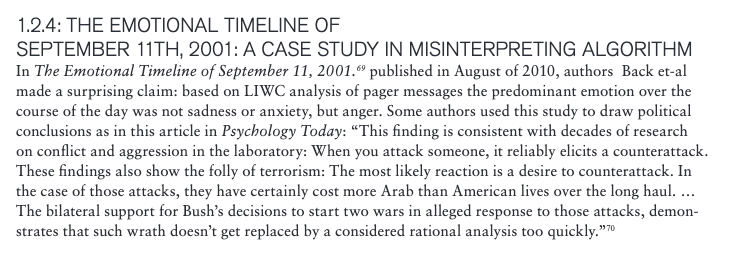
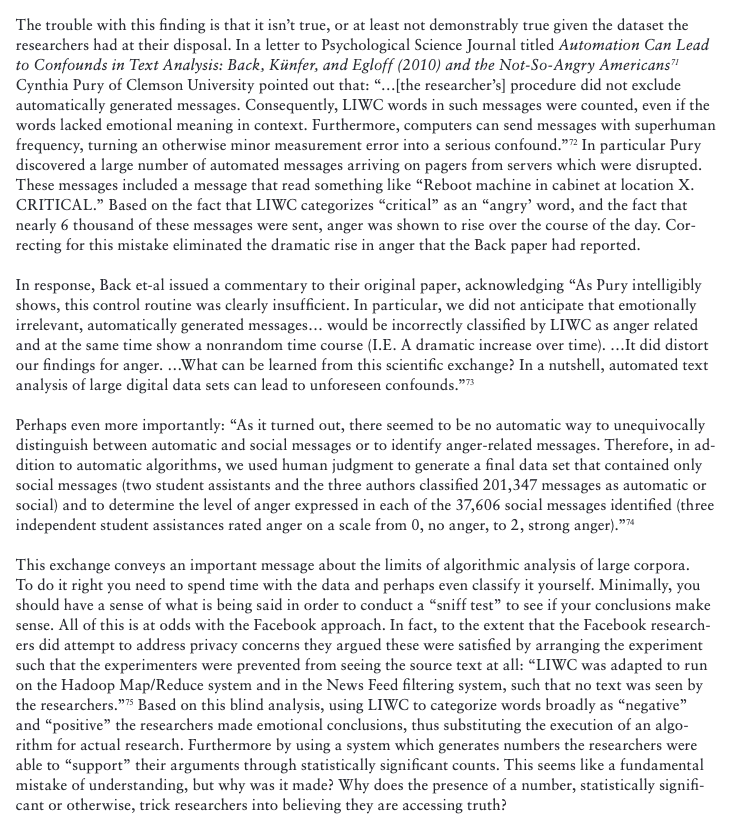
To be clear I was far from the only person noticing this, but I noticed something else as well: as with 9/11 the response to the confusion wasn't reflection, it was an explicit attempt to use the fear to advantage, as both a business and political strategy, and that set the stage for the following decades.
For me, that's the overriding legacy of 9/11: It represented the actual inflection-point where the purpose of media, online and off, collapsed from fact-finding to fact-creation. Not part-time, but full-time, across the spectrum and back. We wrote-off the very idea of objective truth as useless, outdated and corrupt and replaced it with: nothing in particular.
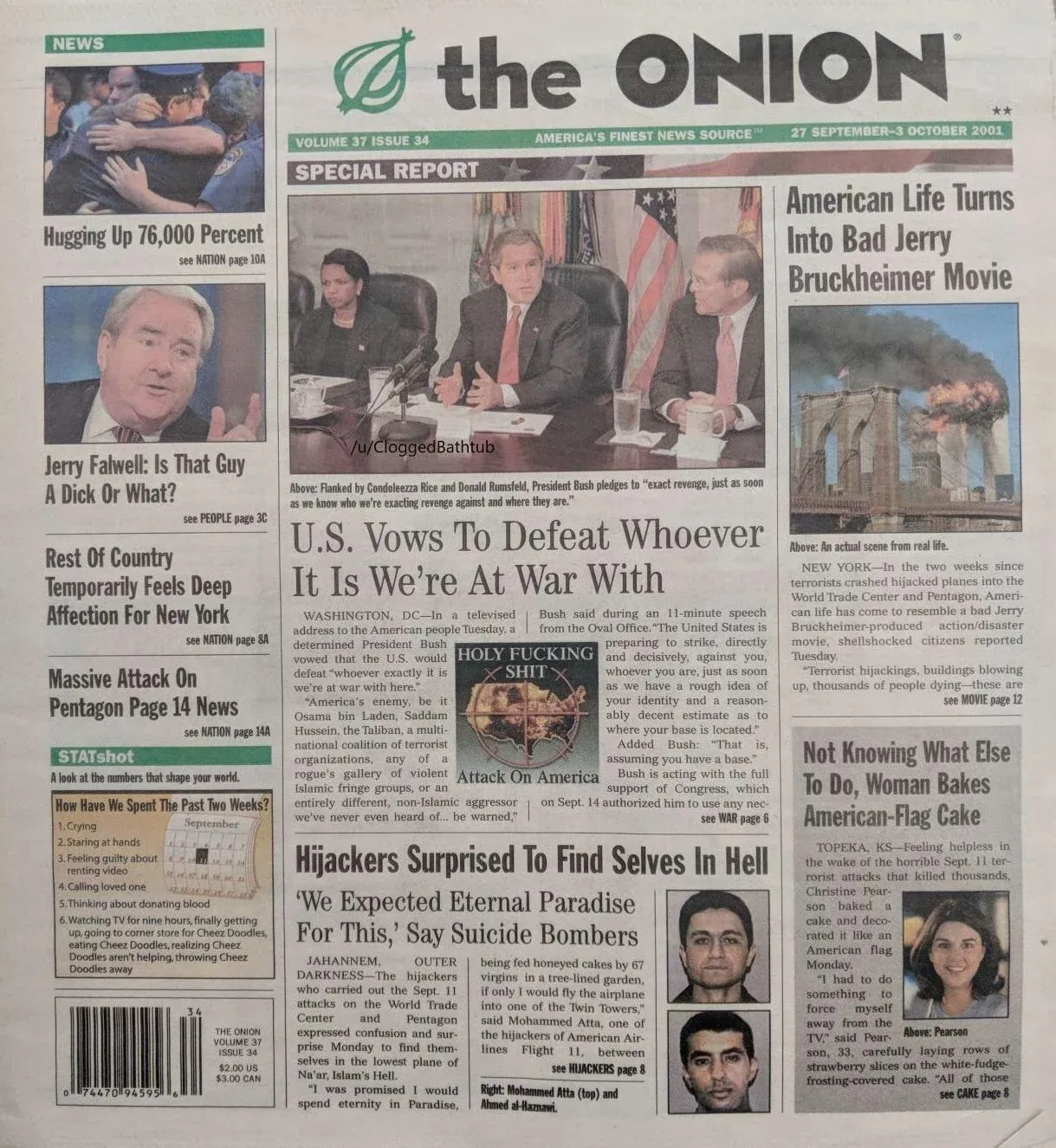
Most of the print media in the weeks following the attack was near useless, repeating the same confused cocktail as day one. The Onion, still a print periodical then, was the only reliable coverage, notable then and now:
Similarly John Stewart's Daily Show, airing on Comedy Central from 1999 to 2015, became the best source of political analysis available, the one reasonable voice online where news became entertainment and entertainment became horror.
It is no surprise to me, having been in Boston on 9/11/2001, that the Onion is doing the only meaningful work online today to counter Infowars, while the current administration concentrates on removing comedians from the airwaves. It is no surprise that the Washington Post is owned by the Amazon Billionaire, or that Netflix owns Movie Theaters following the collapse of the Paramount Consent Decree or that our public officials are completely uninterested in their actual jobs. It does not surprise me that Six-Apart sold LiveJournal to the Russian government so they could have the servers. It does not surprise me that Meta is removing encryption and Telegram is a wing of the FSB. It doesn't surprise me that Facebook manipulates ineffective regulation into more market control. Nothing is too surprising anymore.
This is hypernormalization in the age of hypertext. The truth is whatever you can broadcast loudest, and the market is an automatic machine. Not dead-internet, deadly internet.
Alt-Everything
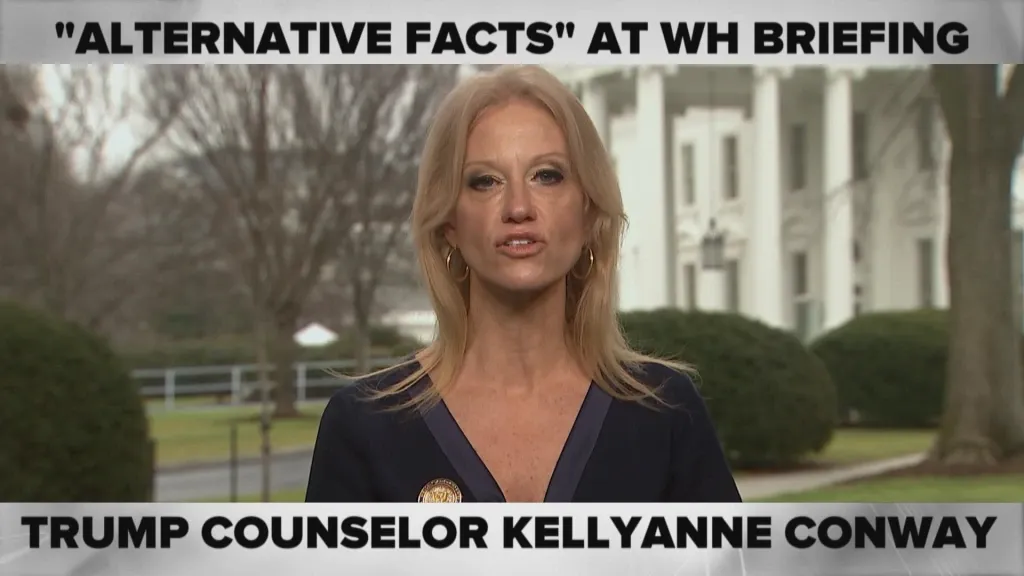
In 2017, When Trump spokesperson Kellyanne Conway appeared on national television to tell use that Trump "wasn't lying, he was just using alternative facts" many people treated it as a joke. Personally, I'd never seen a broadcast more terrifying. This was not a gaffe, it was a clear and precise statement of strategy.
In the years since, I've grown to understand (as a researcher, developer and designer engaged in social media) that I was profoundly wrong about one thing: I used to believe that the folks building and hosting social platforms misunderstood what was happening, I believed that the researchers and engineers employed by these companies were fundamentally good people. I believed the management itself were at best confused and that if they could be made to understand how incredibly powerful these systems are, how much they can provide community and spaces for exploration that bolster humanity, that they would want to shelter and protect this power.
I believed in a better world.
I no longer believe any of that.
The owners and operators of these platforms believe, at best, that they are the exception to the rule: a parochial, colonist view that their paternal guidance is the best for everyone. The believe they are good people and will make the right decisions (and get rich in the process). They are wrong on all counts, and the cracks are showing.
On a personal level I deeply regret contributing my skills to the social-media tech industry, and I think we really need to start over. I also don't expect I'll live to see anything of the sort, but I do feel the tiniest bit better for saying it out loud.
What we did in the years following 9/11 was largely a mistake. The systems we tore out and replaced with fragile, unreliable data-centers, that was a mistake. As online/so offline, that was a mistake.
It's true that having invested all of our capital into the data centers, we started to believe they were more important than the communities that occupied them. The day the planes hit the tower, the day those same servers started angrily screaming "critical - network outage" was the day we decided those racks mattered more than the people lying silent under the toxic rubble.
We cleaned up, paved over and built our memorials, but I think we should start digging now. I think we should remember.