LLMs are Temu Intelligence
In my last newsletter I talked a lot about the effort that's gone into getting you to believe the services you use are free. I think the LLMs-as-AI industry specifically weaponizes this infrastructural amnesia in exactly the same way that the fast-fashion industry does.
LLMs-as-AI are a lot like fast-fashion: cheap, poor quality and seductive, but "good enough." They are also both built with a very particular infrastructural amnesia in mind: you are meant to ignore the delivery mechanisms and their consequences and just "enjoy the moment."
"Shop Like a Billionaire" is Temu's slogan, implying that your range of choice is infinite while also absolving you of responsibility and consequence. Who really cares what you buy if the results aren't going to be around long enough for you to have buyers-remorse anyway?
For software development, LLMs are insanely useful. Also, any engineer who has spent any time writing production code (myself included) will tell you they only really work as a productivity tool in the hands of an experienced developer who understands the real-world consequences of software. Someone who knows better and understands the consequences and tradeoffs of various choices. Pointing an LLM at an abstract problem and pulling the trigger is fun (even satisfying) but the solutions it produces by itself are, at best, temporary and insufficient. Rather than memory palaces, dialogue with an LLM produces Ptomkin villages of intelligence, giving you the emotional satisfaction of believing you have insight while requiring none of the effort. This is dunning-kruger-as-a-service.
Like fast-fashion, the only solution to LLM-As-AI is more LLM-as-AI. Your Temu dress is unlikely to survive a wash, which is ok since you can just order another. Your AI generated project is unlikely to survive very long on the open internet, which is ok because you can just use the AI to troubleshoot and fix it. This is ideal for the "intelligence as a service" industry but does not bode well for anything worth building long term (which begs the question: is anyone actually building for the long haul anyway?).
Asbestos, The Miracle Material
Wired magazine recently described COBOL as "the Asbestos of programming langauges" which I don't think is particularly fair to COBOL, but is probably a reasonable critique of LLMs. That shit is in everything these days, and the consequences are only likely to be felt in a generation, long after the AI company servers have gone dark and there isn't one developer left on earth who you can pay enough to untangle the mess they've made.

The COBOL story is also worth understanding because of the uncomfortable truth for those of us that take our design and engineering seriously: nobody bought the story that our craft mattered. Nobody really believes in quality, care, safety or reproducibility. These elements of craft are luxury items reserved for billionares. You, my friend, are entitled only to the knockoff.
Most software development techniques, from waterfall to agile, from semantic-versioning to inline documentation to no-comment code and everything in-between, are rituals designed to enable humans (including our future selves) to make use of code in a different context, on a different day, with a different understanding of the world. This is building for the future, but none of that is necessary if your code isn't meant to last.
Doing a Ratner
Clothing for children is often cited as a good use of fast-fashion: clothes are expensive, and indeed as a parent I can attest how frustrating it is buy someone an entire wardrobe only to find out it's unwearable in a few weeks. Similarly, an uncomfortable truth is that most code is expected to fall apart: software is an event more than a static object, and in a world driven by "product" designers whose vision is constrained to 3-6 month cycles and measured only in A/B tested user journeys, maintaining the enduring quality of the underlying system is not only considered slow, it's a nuisance to be dealt with.

Thus lack of quality is often sold as accessibility. Temu doesn't require you to be a billionaire, only to want to mimic their spending habits. LLMs for code don't invite you to craft knowledge or build a design pattern or architect a codebase, only to fake it long enough to get through your next standup meeting.
"Getting away with it" seems to be the point.
In 1991, Gerald Ratner, CEO of a chain of popular cut-rate jewelry stores in the UK whose slogan included "we're on your side" tanked his company completely by saying the quiet part out loud:
We also do cut-glass sherry decanters complete with six glasses on a silver-plated tray that your butler can serve you drinks on, all for £4.95. People say, "How can you sell this for such a low price?", I say, "because it's total crap." ...one of the sets of earrings was "cheaper than a prawn sandwich... but I have to say the sandwich will probably last longer than the earrings."
The gaffe resulted in the company crashing and burning so hard it only recovered after Ratner was fired and the company renamed itself, giving rise to the phrase "Doing a Ratner" to describe a CEO speaking out of turn.
But that was 1991, and this in 2026, and the lesson we learned wasn't to speak the truth nor was it to improve quality, only to figure out how to sell that discrepancy as a service while reserving actual quality for the increasingly shrinking pool of uber-wealthy that can afford it.
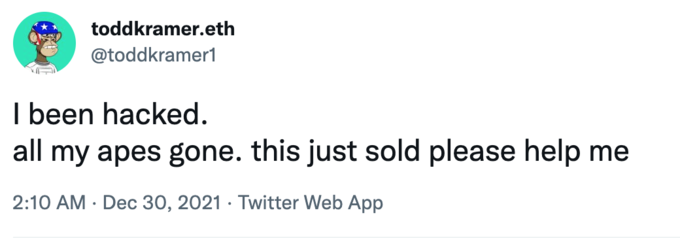
I'm afraid the best we can do now is a Todd Kramer.
All apes gone.
Goodnight.